


Overview
Check out the official campaign website for more information, and up-to-date ways to get involved: makepolluterspaywa.org!
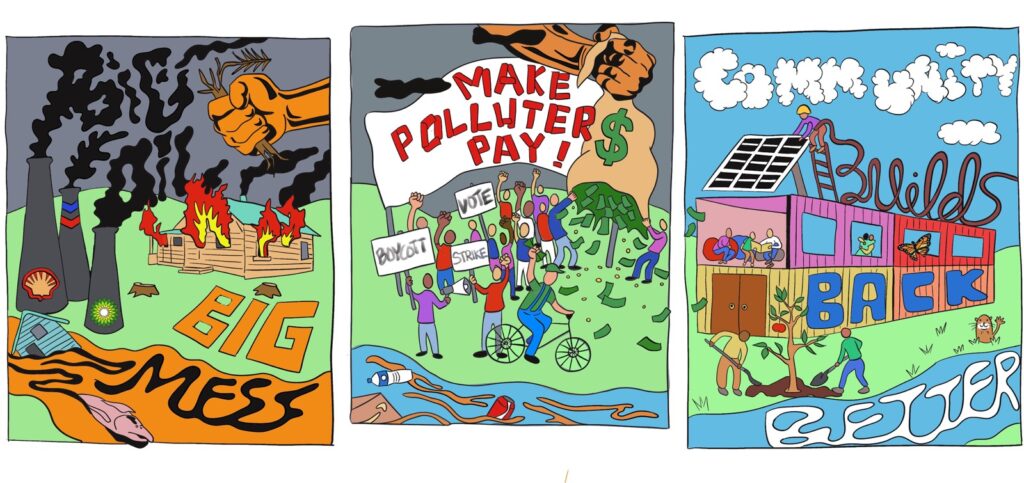
Big Oil companies like Chevron and Exxon have known about the dangers of climate change for decades. They waged massive disinformation campaigns to deceive the public, costing us precious time and causing immense damage to our health, communities, and the climate. While fossil fuel giants continue to rake in record profits, we are left to foot the bill and bear the brunt of climate-fuelled disasters.
From record breaking heat waves, wildfires, drought, and sea level rise to the growing toll on ecosystems and public health, climate change is devastating communities across Washington. In December of 2025, our state experienced record-shattering flooding that swept away homes and businesses, damaged roads and infrastructure, and cost over $180 million. These disasters alongside other climate-related hazards and health impacts are only growing more frequent, deadly, and costly. The climate crisis is making life more expensive for households too. Working families across the state are paying unaffordable home insurance rates, and higher fuel, energy, healthcare, and food costs.
And Big Oil keeps cashing in. The oil and gas industry earned a profit of more than $102 billion in 2024, yet they’re not paying a dime toward the cost of the destruction they helped cause.
What if we could make Big Oil companies reinvest some of their massive profits in Washington to help build resilient, safe, and healthy futures?

We’re joining a nationwide movement to hold the fossil fuel industry accountable by passing Climate Superfund legislation, requiring them to pay their fair share for climate damages they have caused our state, and fund critical climate resilience measures to support local communities.
At a time when the federal government is gutting funding for climate and doubling down on fossil fuels, a Climate Superfund would allow Washington to act independently, creating a protected funding stream that no administration can touch. We need dedicated, long-term funding to rebuild, adapt, and protect our communities. Climate Superfunds make that possible.
It’s time to make polluters pay.

Frequently Asked Questions
What is climate superfund legislation?
A Climate Superfund policy would ensure that the largest polluters pay their fair share for the climate damages they have caused in Washington. The bill establishes a program to collect funds from the biggest polluting companies to help the state pay for climate-related damages, resilience, response, mitigation, and adaptation measures. Importantly, funds will be prioritized for projects that benefit communities hit hardest by fossil fuel pollution and climate change.
The first Climate Superfund bill was passed in Vermont in Spring of 2024. New York followed suit with Governor Hochul signing the second Climate Superfund bill in December of 2024. Climate Superfund bills have been introduced or re-introduced in California, Oregon, Minnesota, Massachusetts, Maryland, New Jersey, and are being considered in several additional states.
Passing Climate Superfund legislation would help hold the fossil fuel industry financially accountable for climate damages, and ensure corporate accountability continues even as federal protections weaken. At a time when the federal government is gutting funding for climate and doubling down on fossil fuels, a Climate Superfund would allow Washington to act independently, creating a protected funding stream that no administration can touch.
Which companies would be held responsible by a climate superfund bill?
The bill requires a state agency (depending on the state) to determine a list of fossil fuel companies to be held responsible. This is usually a set of “super-emitters” that have contributed more than 1 billion metric tons of CO2-e GHG emissions globally over an established period (usually around 30 years), and that have sufficient connections with the state of Washington (for example, selling their products here).
Companies that meet this threshold are subject to payment obligations calculated based on climate damages to the state, and their share of emissions over that established or “covered period”.
This will limit the total number of payors to the biggest polluters (such as Exxon, Chevron, Shell, BP, and so forth), with those who polluted the most paying the most.
What would a climate superfund pay for?
A Climate Superfund can be used for a host of climate resilience, adaptation, response, and mitigation projects, with a percentage of the funding dedicated for frontline communities. Projects can include: investing in upgrades for low-income housing or schools to better withstand heat waves and other extreme weather; implementing measures to protect people from wildfires, such as home hardening in at-risk areas; repairing roads, bridges, and other infrastructure damaged by extreme weather events; restoring wetlands, and completing similar climate resiliency projects; upgrading stormwater management systems to prevent flooding in vulnerable neighborhoods, and more.
How much will a climate superfund raise?
Each state’s cost calculations vary based on climate impacts to the state and the proportional share of emissions attributable to each responsible party during the covered period. New York for instance is slated to bring in $3 billion per year over the next 25 years, for a total of $75 billion—a fraction of the total estimated cost of climate damages to the state. Broadly, a Climate Superfund promises to be a significant and consistent revenue generator for the state, creating a protected funding stream that no federal administration can touch.
Is there a precedent for campaigns like this?
Yes! Climate Superfund is modeled on existing federal law. The Climate Superfund concept builds on the same legal principles that underlie the federal Superfund program, established by Congress in 1980 through the Comprehensive Environmental Response, Compensation, and Liability Act (CERCLA) to fund the cleanup of hazardous waste sites – a.k.a the Environmental Protection Agency’s Superfund program!
Climate Superfund bills take the longstanding “polluters pay principle” and extend it beyond traditional hazardous pollution of water or land to include GHG emissions.
Climate Superfund legislation enacted in Vermont and New York is grounded in CERCLA’s similar retroactive, strict liability program designed to deal with the impact of past pollution—this approach holds large fossil fuel producers and refiners strictly liable for costs arising from their products’ GHG emissions irrespective of whether they intended the harm or wrongdoing, or are deemed to have acted improperly.
Washington’s Climate Superfund bill would also be similarly modeled on existing state and federal laws: CERCLA and Washington’s Model Toxics Control Act (MTCA), which became law in 1989. MTCA’s main purpose is “to raise sufficient funds to clean up all hazardous waste sites and to prevent the creation of future hazards due to improper disposal of toxic wastes into the state’s lands and waters.” (RCW 70A.305.010). MTCA has been amended several times but one of its key principles remains in place today: polluters pay.
Will costs be pass on to consumers?
This is highly unlikely. Economic analysis by the Institute for Policy Integrity in New York, research by economics Professor Claire Brown in California, and testimonial by Nobel Prize winning economist Joseph Stiglitz show that gas prices are not likely to be affected by a Climate Superfund.
Companies can’t simply raise local prices to cover these costs because:
- Gas prices are set by the global oil market, not individual companies
- They would lose customers to competitors who don’t have to pay
- The law is based on past pollution, not current production, so it doesn’t affect day-to-day costs
- Even major oil companies have to accept losses when global prices drop—they can’t just raise prices whenever they want
- Any potential price collusion among payers would violate antitrust laws, and state consumer protection laws
Another way to say all of this is that the retroactive assessment is a fixed cost rather than a marginal cost. Fixed costs do not affect incentives because they do not change based on production levels.
Right now we’re left footing the bill for climate damages while oil companies make record profits to line their CEOS’ and shareholders pockets. Climate Superfunds ensure these companies help pay their fair share.
How is this different from carbon pricing, and from the Climate Commitment Act?
A Climate Superfund would be distinct from the Climate Commitment Act, which is a Cap-and-Invest program. Climate Superfund is a retroactive fee for climate damages to the state resulting from past greenhouse gas emissions, and not a penalty for future emissions, like Cap-and-Invest programs. Washington is most similar to California in this respect given California’s Cap-and-Trade program.
Through a Climate Superfund, fossil fuel companies must pay a fee to address damage caused by past or historic fossil fuel emissions. In contrast, Cap-and-Trade or Cap-and-Invest programs are market-based programs to incentivise future emissions reductions. Funds collected through Washington’s Climate Commitment Act do not compensate for past damages caused by companies’ emissions.
Additionally, a Climate Superfund targets only a set of “super-emitters” that have contributed more than 1 billion metric tons of CO2-e GHG emissions globally over an established period. These companies have evaded all accountability for the harm caused by their past emissions, leaving the State and its taxpayers to foot the bill. A Climate Superfund bill seeks to address that injustice based only on what is fair. If not, working families in Washington will continue to have to pay for harms caused by multibillion-dollar fossil fuel corporations.
Learn More
Climate Superfunds
- Introducing Polluters Pay Laws—a New Tool for Climate Adaptation
- Make Polluters Pay Website
- How New York’s $75 Billion Climate Superfund Will Work
- Vermont officially becomes 1st state to charge big oil for climate change damage
- What You Need to Know About Climate Superfund Bills
- New Yorks Climate Superfund Bill
- How a Climate Superfund Works
- Carbon emissions from oil giants directly linked to dozens of deadly heatwaves for first time
- Climate Loss and Damages cost $16 Million Per Hour
- US Spending on Climate Damage Nears $1 Trillion Per Year
Big Oils deception and profits
- Energy Profits | History-making profits. World-ending emissions.
- Big Oil knew as early as 1954
- Inside Exxon’s Strategy to Downplay Climate Change
- Fossil Fuel Industry Funded Climate Science in 1954- evidence
- Shell Documents Reveal Deep Knowledge of Effects of Fossil Fuels
- A Climate of Concern- produced by Shell
- Climate Change Hazards Statement By the American Petroleum Institute President 1965
- Early Oil Industry Knowledge of C02 and Global Warming
Gas Prices
- Enacting the “Polluter Pays” Principle: New York’s Climate Change Superfund Act and Its Impact on Gasoline Prices
- Nobel Prize Winning Economist to NY Gov: Superfund Act Will Save New Yorkers Money
- Polluter Pays Climate Superfund Act Supports State Climate Policies Economic Evaluation of SB 684 & AB 1243 (California)